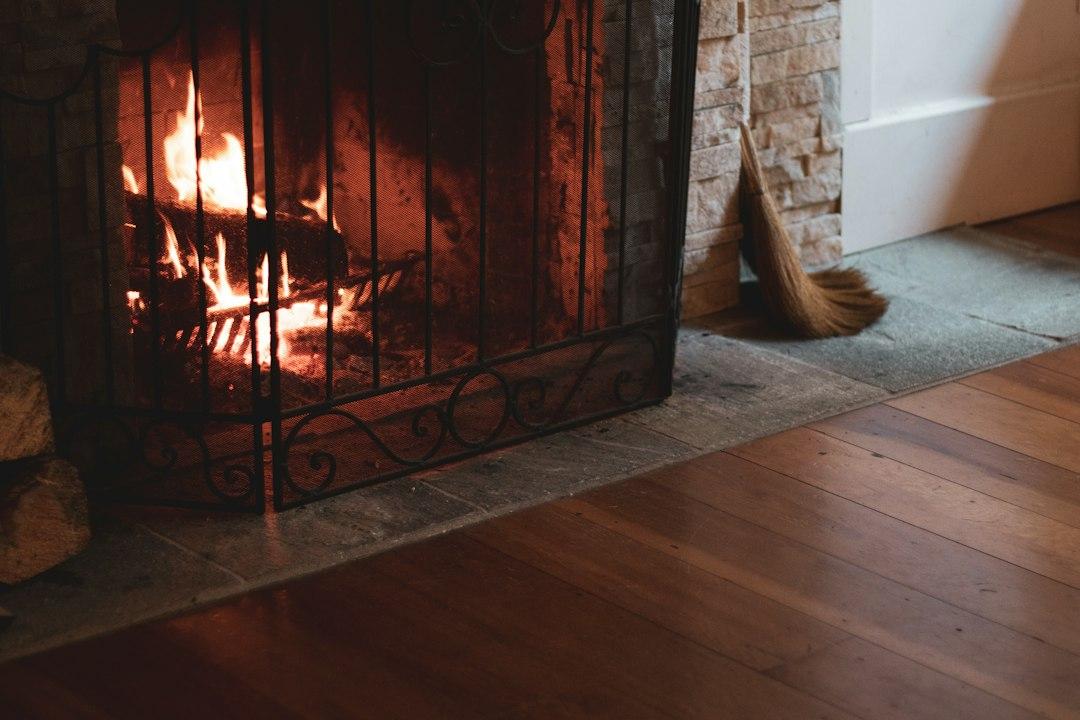
An open masonry fireplace is a poor heater. Most of the warmth goes up the flue with the smoke, and on a cold night it can pull more heated air out of the room than it puts back. Owners in Orange who want the hearth to actually warm the house usually end up choosing between two sealed boxes that slide into the old opening: one that burns split wood and one that burns gas. Both cure the draft problem. They differ in nearly everything else.
This comparison is written from the point of view of people who like burning wood and are deciding whether to keep doing it.
What both kinds have in common
A wood insert and a gas insert are both steel boxes with a glass front, set into the existing firebox and trimmed with a surround that covers the gap. Each has a blower that pushes room air around the box and back out warm. Each needs its own flue path to the top of the chimney, because the old masonry flue is far too large for a closed box to draft through properly.
That flue path is where a lot of the cost and most of the safety sits, and it is also where the two options start to part ways.
The wood insert
Heat. A good wood insert puts out serious heat, enough to warm the main living area of most houses here on its own. It works when the power is out.
The flue. It needs a stainless liner sized to its outlet, running the whole height of the chimney and sealed at the top. This is not optional and it is not cheap, especially on a tall chimney.
Upkeep. Wood smoke leaves deposits. A wood insert needs sweeping at least once a season if it is used regularly, and the insert often has to be pulled forward to reach the liner connection. Seals, firebrick and the internal shelf wear like any stove.
Fuel. It needs dry, split hardwood, stored under cover, and someone willing to haul it in.
Rules. Orange is inside the South Coast Air Quality Management District. On days the district declares no-burn days under Rule 445, wood burning stops, insert or not.
Price. We do not publish a figure for wood inserts, because the unit, the liner length and the condition of the old firebox vary too much. You get a written price after we have measured.
The gas insert
Heat. Less than a large wood insert, but steady and controlled from a wall switch or a remote. Many run without house power on a pilot.
The flue. It needs its own vent run up the chimney, usually two flexible pipes or one pipe inside another, one carrying exhaust out and the other bringing outside air in. The fire never draws on room air.
Upkeep. No tar, no ash. A yearly service of the burner, pilot, glass and vent is enough for most units.
Fuel. A gas line to the hearth. Many older Orange houses already have one, for a log lighter or an old gas log set.
Rules. Burning gas is not wood burning, so the Rule 445 no-burn days do not stop it.
Price. On our list, a gas insert set into the fireplace you already have, with its vent, runs $2,850 to $5,750 installed. The spread reflects the size of the unit, the finish around it and how much the old firebox needs.
Side by side
| Point | Wood insert | Gas insert |
|---|---|---|
| Fuel | Split, dry hardwood | Natural gas |
| Works in a power cut | Yes | Most do, on the pilot |
| Flue | Full stainless liner to the top | Two-way vent to the top |
| Sweeping | Every season with regular use | Not needed; yearly service instead |
| No-burn days | Must stay unlit | Unaffected |
| Our price | Written price after measuring | $2,850 to $5,750 installed |
What decides which is right for your house
Three questions usually settle it.
- Do you enjoy the wood? If splitting, stacking and tending a fire is part of the point, a gas flame will feel like a picture of a fire. If the wood has become a chore, gas wins quickly.
- How much do you rely on it? A house that leans on the hearth as a main heat source on cold nights is better served by wood. A house that wants a warm room in the evening is well served by gas.
- What shape is the chimney in? Both need a sound flue path. If the chimney needs a large repair anyway, that cost goes on top of either choice, and it may make one of them cheaper to finish than the other.
The fastest way to an answer is a look at the fireplace and the chimney. Ask for a written insert price through this form and tell us whether you lean toward wood or gas, what the fireplace looks like now, and whether there is a gas line nearby.
What about a stove instead?
Some owners skip the insert altogether and set a freestanding stove on the hearth, piped into the chimney. That gives more radiant heat and a bigger window on the fire, but it takes up floor space and needs proper clearances to the mantel and walls. We cover the trade-offs on the fireplace inserts page, and the repair side of stoves in Wood Stove Repair Costs.
How we put either one in
Either way, the job starts with an inspection of the firebox and flue, because an insert hides the old fireplace from view once it is in. We clear the flue, check the smoke chamber and the damper area, measure the opening, and confirm the chimney can take the liner or vent the unit needs. Then you get a written quote covering the unit, the flue work, the surround and any repair the chimney needs first. Our gas fireplace repair service looks after the gas side once it is running; the chimney sweep keeps a wood insert clean.
If the open hearth in your Orange living room is more decoration than heater, it does not have to stay that way. Tell us which way you are leaning on our contact page and we will come and measure.
Want This Looked At on Your Own Stove?
Booker Chimney Contractors repairs wood and pellet stoves and sweeps flues out of Orange. The contact page takes the appliance and its trouble, and we call back with a visit and a price where one is listed.